Yoga Nidra and Sleep: An Honest Guide
Publicerad 2026-07-15
It is 2am and you are doing the maths again. If you fall asleep right now, that is five hours. Four and a half. Four.
Somewhere around the third night, the tiredness stops being the problem. The problem becomes the trying.
The trap nobody warns you about
Sleep is one of the few things that gets further away the harder you chase it.
Effort requires alertness. Alertness is the opposite of falling asleep. So the moment you start working at it — checking the clock, calculating, willing yourself under — you have guaranteed the thing you are trying to prevent.
This is why "just relax" is such useless advice, and why every technique that treats sleep as a task you can win eventually backfires. You cannot perform your way into unconsciousness.
What you can do is build the conditions and then get out of the way. That distinction is the entire point of this guide.
First: when this is not a yoga problem
Please see a doctor before you start if any of this is you:
- You snore heavily, or someone has seen you stop breathing during the night
- You are exhausted no matter how many hours you spend in bed
- You wake gasping or with a dry mouth and a headache most mornings
- You have unbearable crawling sensations in your legs at night
- Your low mood or anxiety is significant in its own right
Sleep apnoea in particular is common, badly underdiagnosed, and does real cardiovascular damage. Breathing exercises do not touch it. If that might be you, get it looked at — that matters more than anything on this page.
And if your insomnia is chronic, know that the first-line treatment with the strongest evidence is CBT-I (cognitive behavioural therapy for insomnia), not yoga. What follows sits alongside that. It does not replace it.
Why the exhale is the only lever you actually control
You cannot instruct your heart to slow down. You cannot decide to release adrenaline. Almost everything in the autonomic nervous system runs without your permission.
Except breathing. Breathing is the one autonomic function with a manual override — and it is wired directly into the same system.
Here is the mechanism, simplified but real: on the in-breath your heart rate rises slightly. On the out-breath it falls. This is called respiratory sinus arrhythmia, and you can feel it if you go looking. Which means a breath pattern with a longer exhale than inhale spends more time in the settling phase.
Not mystical. Plumbing.
This is why nearly every calming breath technique across every tradition converges on the same thing: make the exhale longer. Four in, eight out. Nothing more sophisticated is required, and sophistication is usually a sign someone is selling something.
Yoga nidra: rest that is not sleep
Yoga nidra translates roughly as "yogic sleep", which is a slightly unhelpful name — you are not asleep, and the goal is not to be.
You lie down, fully supported, and a voice guides your attention systematically — usually around the body, then the breath, then some imagery. You do nothing. There is no posture to hold, nothing to achieve, and no way to be bad at it.
What makes it interesting is the state it produces: the body deeply at rest, the mind not quite gone. Practitioners have described it for a very long time; what modern work adds is that this hovering state seems to be genuinely restorative rather than merely pleasant.
Let me be careful here, because this is where the internet gets silly. You will read that thirty minutes of yoga nidra equals four hours of sleep. That claim has no serious evidence behind it and I would not repeat it. Nidra is not a sleep replacement.
What the research does suggest — and the honest summary is "promising, still thin" — is that nidra and similar guided-rest practices can reduce measures of stress and improve sleep quality. Judith Lasater's Relax and Renew is the classic on restorative practice generally, and it is good precisely because it does not overclaim.
Here is the practical thing, though, and it is the reason I teach it:
Nidra gives you something to do at 2am that is not trying to sleep. That alone breaks the loop. You are no longer failing at a task — you are doing a practice. And people very often fall asleep during it, precisely because they stopped attempting to.
Do it in the daytime too
Most people file nidra under "bedtime". That is a waste of it.
A twenty-minute nidra at three in the afternoon does something a bedtime one cannot: it lowers the load you are carrying into the evening. Much bad sleep is not made at 11pm. It is made at 3pm, by a nervous system that never got to come down all day and arrives at bedtime still running.
This is also why it is a practice rather than a sleep aid. Treat it as a tool you only reach for in a crisis and it will work about as well as any other panic measure.
The unglamorous things that matter more
I would be doing you a disservice if I let you believe yoga is the main lever here. It is not. These are, and they are boring:
- Get up at the same time every day. Including weekends. Wake time anchors the whole system far more than bedtime does.
- Get light in your eyes early. Outdoor light within an hour of waking, even on a grey day. It is the strongest signal your body clock has.
- If you cannot sleep, get up. Lying in bed frustrated teaches your brain that bed is where you lie awake. Get up, sit somewhere dim and dull, go back when sleepy.
- Watch the caffeine curfew. Caffeine has a half-life of around five to six hours. The 4pm coffee is still substantially present at 10pm.
- Alcohol is not a sleep aid. It knocks you out and then fragments the second half of your night.
Yoga helps around the edges of these. It does not outrank them.
What an evening practice should actually be
Short. Boring. Repeatable. Ten to twenty minutes.
Supported shapes with props doing the work — the more your body is held, the less it braces. Long exhales. Nothing that raises your heart rate, nothing that requires concentration or achievement, nothing new.
Not a strong practice. Not a flow, not backbends, not anything that leaves you feeling accomplished. Accomplishment is stimulation. Save it for daytime.
The best evening practice is one so undemanding you will still do it on the night you least want to.
A five-minute version, tonight
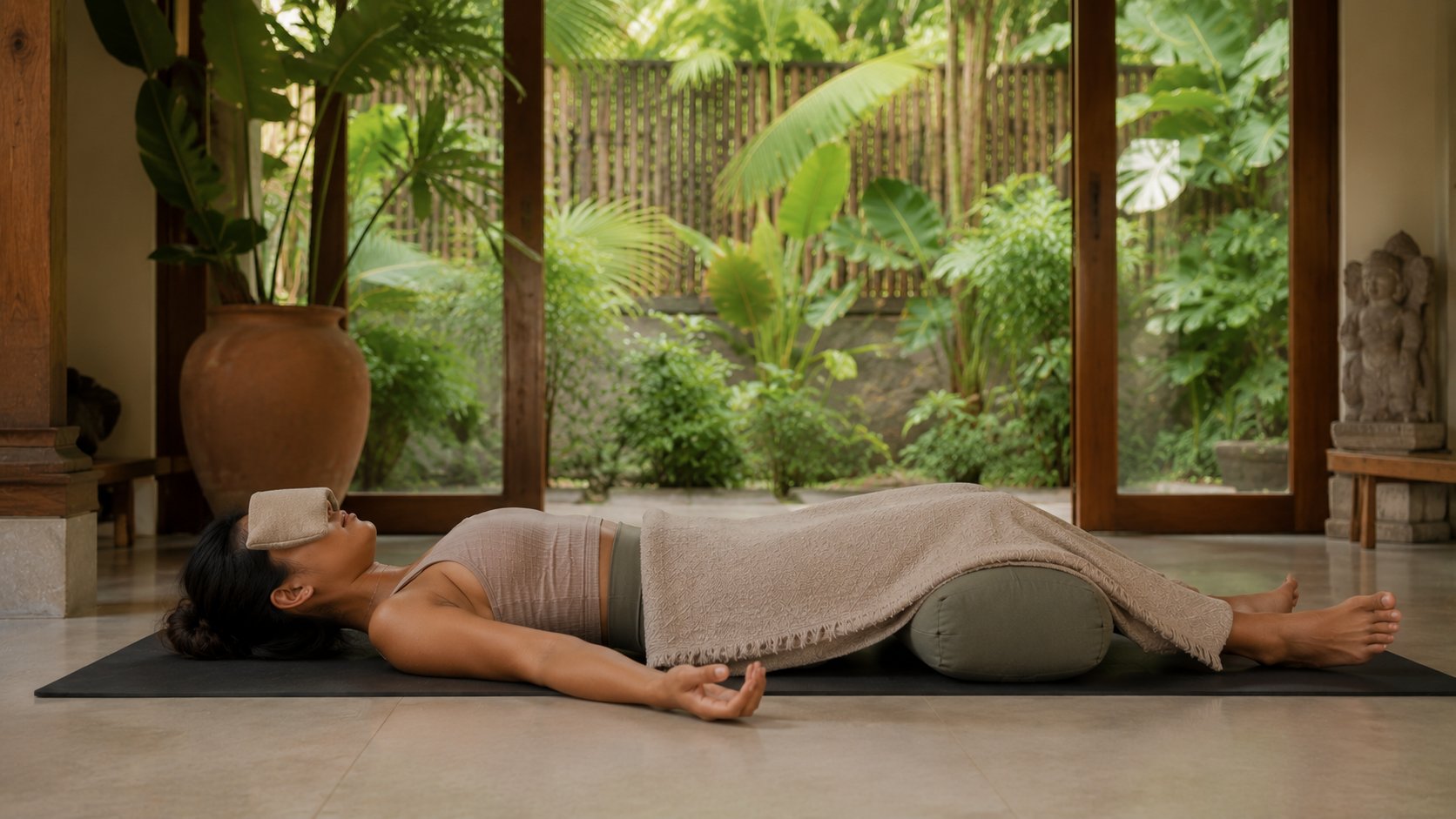
Lie on your back. Put your calves up on a chair or the edge of the bed, so hips and knees are at right angles. A blanket over you. Something soft on your eyes if you have it.
Breathe in through your nose for four. Out for eight. Do that ten times, without counting perfectly and without minding when you lose track.
Then stop counting and just lie there for a couple of minutes, doing nothing at all.
That is the whole thing. If you fall asleep on the floor, that is not a failure — that is data.
How long until it helps?
Some people sleep better the first night, usually because they stopped fighting rather than because anything changed physiologically.
For most, it takes a couple of weeks of practising most evenings before the pattern shifts — and it shifts unevenly. You will have a good week and then a bad night, and the bad night will feel like proof it is not working. It is not proof. Sleep is noisy.
The people it works for are the ones who kept a short practice going through the noise.
Where to start
Do the five-minute version above, tonight, and again tomorrow. Do not add anything for a week. And fix your wake time before you touch anything else — it is free and it outperforms everything on this page.
If you want the full path — the breath, the nidra, and an evening routine built around your actual life — my online course for better sleep is a four-week version, including a private session with me.
And if you want to learn to guide these practices for other people, our 50-hour facilitator training in Yoga Nidra and meditation is where we teach the method itself.
About the author
I am Oka Pastini, a Balinese yoga teacher born and raised in a village in Bali. I have been teaching since 2019 — across Bali, throughout the Indonesian archipelago, and in Europe — and more than 5,000 people have practised with me. I hold a 500-hour Hatha Yoga certification along with 100-hour trainings in Aerial and Yin Yoga, and deepened my practice in Rishikesh, India. More about me here.
I am a yoga teacher, not a doctor. This guide is education, not medical advice.
Related
Yoga for lower back pain: an honest guide — poor sleep lowers pain thresholds, which is why these two problems so often arrive together.
Sources
- Lasater J. Relax and Renew: Restful Yoga for Stressful Times. Rodmell Press.
- Riemann D, et al. "European guideline for the diagnosis and treatment of insomnia." Journal of Sleep Research, 2017 (CBT-I as first-line treatment).
- NICE Clinical Knowledge Summary: Insomnia.
- Datta K, et al. "Yoga nidra practice shows improvement in sleep in patients with chronic insomnia." Indian Journal of Medical Research, 2021.
- Saper R, et al., and the wider literature on breath regulation and heart rate variability.
- Kaminoff L, Matthews A. Yoga Anatomy. Human Kinetics.


