Why Are My Hips Tight? An Honest Guide to Hips and Yin Yoga
Publicerad 2026-07-15
You have been told your hips are tight for so long that you have stopped questioning it. You stretch them. They stay tight. You stretch harder. Your knee starts complaining. You conclude that you are simply not built for this.
You are half right. You are built differently. But almost everything else in that story is worth taking apart.
The most useful thing anyone ever told me about hips
Your hip socket is not the same as the person's next to you. Not slightly — substantially.
The depth of the socket, the angle it faces, the length and twist of the femoral neck: all of it varies enormously between individuals. Some people have sockets that face more forward, some more to the side. Some femoral necks meet the shaft at a wide angle, some narrow. These are not flaws. They are anatomy, and they were set long before you took your first yoga class.
Bernie Clark's work — Your Spine, Your Yoga and The Complete Guide to Yin Yoga — is the clearest writing on this, and it is worth your time if a shape has ever felt permanently locked. His point is blunt and freeing: you cannot stretch bone. When your femur meets the rim of your socket, that is the end of the range. Not a stretch you have not earned. The end.
Which means the person effortlessly folded into lotus in the photo is not more disciplined than you. They have a different skeleton.
"Tight" usually means three completely different things
People use one word for at least three situations that need opposite responses.
1. Compression
Bone meeting bone. It feels like a hard, sudden, unyielding stop — often at the front of the hip crease, and it does not ease no matter how long you wait. Stretching does nothing here. Pushing past it is how hip joints and knees get hurt. Learn to recognise it and change the shape.
2. Tension
Soft tissue at its length. It feels broad, warm, and slowly gives when you stay. This is what stretching is for.
3. Guarding
The muscle is not short — it is on. Your nervous system has decided this range is unsafe and is holding the brake. It often shows up as a hip that is tight at 7am and fine at 7pm, or tight before a meeting and fine on holiday. Stretching a guarded muscle is arguing with a security system. It usually wins.
Most of what people call "tight hips" after years of sitting is the third one, with a bit of the second. Which is why stretching harder — the obvious move — so reliably fails.
What sitting actually does
Eight hours a day at roughly ninety degrees, and the hip never visits the ends of its range. Not because the range is gone, but because nothing has asked for it since roughly 2019.
The body is efficient. It maintains what you use. Ranges you never visit get quietly downgraded — not lost, but no longer trusted, no longer strong, and therefore protected.
The fix is not to yank the range back. It is to visit it, gently and often, and to be strong enough there that your nervous system stops treating it as a threat.
Why mobility is not flexibility
This distinction is the whole game.
Flexibility is how far you can be moved — passively, by gravity, a strap, or a well-meaning teacher.
Mobility is how far you can move yourself, under control, with strength through the range.
Flexibility without strength is not an achievement. It is a joint operating in a range it cannot support. That is exactly the person who gets flexible and then gets injured, and it is depressingly common in yoga.
So the goal is not to be folded further. It is to own more of your range. That takes strength work in the positions, not just longer holds.
So what is Yin yoga actually for?
Yin gets misunderstood in both directions. It is not just "slow stretching", and it is not a mystical technology either.
Yin means long, unforced holds — three to five minutes — in shapes supported by props, with the muscles deliberately off. The idea is that where a short, active stretch mostly speaks to muscle, a long, quiet hold gives you time to work with the denser tissue around the joint, and — more importantly in my view — time for the nervous system to stop guarding.
Three to five minutes is long enough for something to change that thirty seconds never touches. Not because the tissue melts, but because you finally stop bracing against it.
The honest caveat: the fascia-remodelling claims made for Yin outrun the evidence. What I can say from teaching it is narrower and, I think, more useful — held long enough, in a shape you are genuinely supported in, people stop fighting. And a hip that has stopped being defended behaves very differently from one that is.
That is also why Yin without props is a contradiction. If you are working to hold the shape, you are not doing Yin. You are doing a long, uncomfortable stretch.
Why your knee hurts in hip stretches
The single most common thing I have to fix.
In pigeon, in cross-legged shapes, in butterfly: if the hip stops before the shape does, the difference has to go somewhere. It goes to your knee — a hinge being asked to twist, which is not its job and it will let you know.
The rule is simple and non-negotiable: knee pain in a hip stretch means come out. Not adjust and endure. Out. Then support the shape with blocks or a bolster until the hip, not the knee, is the thing being asked.
What actually works
- Find your real end range, without judgement, and learn what compression feels like so you stop pushing into it.
- Support everything. A hip that feels safe lets go. A hip hanging in space braces.
- Hold long, or move strong — not both at once. Yin holds to release guarding; active strength work to own the range.
- Go often, not hard. Ten minutes most days beats an hour on Sunday, for reasons that have more to do with your nervous system than your tissue.
- Stop comparing. Genuinely. That photograph you are measuring yourself against is a different skeleton.
Shapes to be careful with
- Deep pigeon without support. The classic knee-wrecker. Put a block under the hip of the front leg — always.
- Forcing lotus. Lotus requires a lot of external rotation at the hip. If your hip will not give it, your knee will. This is where serious injuries happen.
- Sitting on your heels for long holds if your knees object. Nothing is being gained.
- Anyone pushing you deeper. Including you.
How long until it helps?
Guarding can change fast — sometimes within one long, well-supported hold, which is why people leave their first Yin class surprised.
Actual usable range takes longer. Weeks, not days, and it comes back slowly if you stop, because it was always about what your body currently trusts rather than what it structurally has.
And some range is simply not coming. That is not defeat. Knowing where your bone stops is more useful than a decade of trying to stretch it.
Where to start
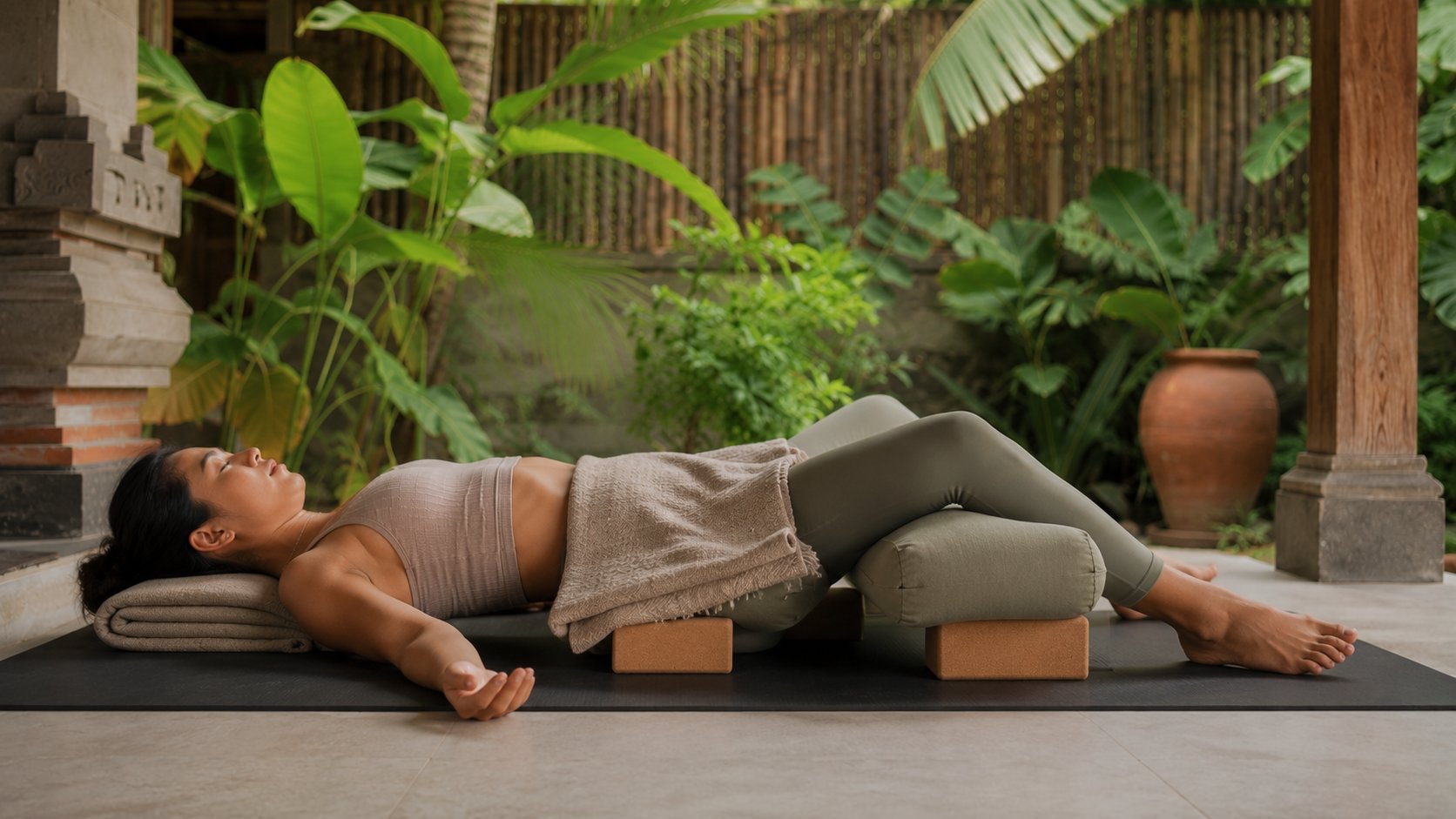
Lie on your back. Put your feet on the floor, let your knees fall together, and just breathe for two minutes. That is not a stretch — it is you finding out how much your hips are holding when nothing is being asked of them at all.
Most people are startled by that one.
If you want the full path — finding your range, releasing the guarding, and building strength so the range stays — my online course for hip mobility is a four-week version, including a private session with me so we work with your hips rather than an average pair.
And if you want to go deeper into the method itself, our 50-hour Yin and Restorative training is where we teach the whole thing properly.
About the author
I am Oka Pastini, a Balinese yoga teacher born and raised in a village in Bali. I have been teaching since 2019 — across Bali, throughout the Indonesian archipelago, and in Europe — and more than 5,000 people have practised with me. I hold a 500-hour Hatha Yoga certification along with 100-hour trainings in Aerial and Yin Yoga, and deepened my practice in Rishikesh, India. More about me here.
I am a yoga teacher, not a doctor. If you have had a hip replacement, a labral tear, or hip pain that wakes you at night, speak to your doctor or physiotherapist before starting.
Related
Yoga for lower back pain: an honest guide — stiff hips and a sore lower back travel together more often than not.
Sources
- Clark B. Your Spine, Your Yoga. Wild Strawberry, 2018.
- Clark B. The Complete Guide to Yin Yoga. Wild Strawberry.
- Grilley P. Yin Yoga: Outline of a Quiet Practice, 10th Anniversary Edition.
- Powers S. Insight Yoga / A Journey Into Yin Yoga.
- Kaminoff L, Matthews A. Yoga Anatomy. Human Kinetics.


